

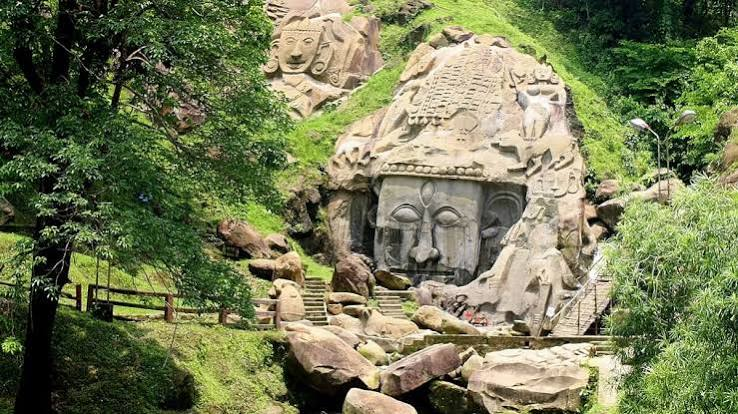
I had seen photographs of Unakoti before travelling to Tripura, but they gave me little sense of its scale. The carvings are spread across a wooded hillside, so I had to move through the site to discover them. One moment I was concentrating on the path. The next, an enormous face appeared in the rock ahead of me. That change from a walk in the greenery to a close encounter with the sculptures stayed with me long after I left.
I chose Kailashahar as my base because Unakoti is about eight kilometres from the town. When comparing hotel stays, I looked for somewhere that would make an early start and the return trip straightforward.
Unakoti’s Unakotiswara Kal Bhairava took me by surprise
I wanted to see the main head of Shiva, called Unakotiswara Kal Bhairava. Its height is approximately 30 feet, and the headdress on top is around 10 feet. While standing in front of the statue, I was particularly looking at the shape of its face and the statue’s other characteristics carved in stone.
I took a step back and examined the statue from a distance, and then went closer. The remaining rock formation and plants surrounding the statue made it look like it had become part of the hill I was walking through, and so I could observe it from different distances.
The figures beside Shiva rewarded a second look in Unakoti
There was more to study around the central head. The district identifies a figure of Durga standing on a lion beside the headdress, with another full-sized female figure on its other side. At first, my attention kept returning to Shiva’s face. Once I looked around it carefully, I began to notice how much else had been carved into this section of rock.
I spent longer there than planned, pointing out details to my companion and following the shapes with my eyes. A second look proved more interesting than the first. Each time I thought I was ready to move on, another line or figure caught my attention.
Unakoti’s Ganesha and the Nandi figures added to the story
As I delved deeper into the location, I searched for the significant Ganesha sculptures and Nandi idols I had heard of in the descriptions of Unakoti. It added to my understanding of the significance of this Shaiva pilgrimage site. As I continued my voyage, I was greeted by these formations throughout the landscape.
The district dates Unakoti’s pilgrimage heritage to around the seventh to ninth centuries, or possibly earlier. I found that remarkable while walking between the sculptures. I kept wondering how the artists had planned figures on such a scale and what the hillside must have looked like as they worked.
The name Unakoti gave the carvings another layer
Unakoti means “one less than a crore,” as a local story goes, that Shiva, while on his way to Kashi from an expedition with a crowd of deities, stayed the night here. The group not waking up on time led to Shiva moving on alone and transforming the rest into stone. This was indeed a legend for me, but as I listened, the way I saw the hills nearby changed. I saw each new depiction and understood the story’s significance.
The greenery and water surrounding the sculptures also played their role in my trip. I walked along the paths slowly and absorbed the surrounding beauty between the large carvings. The mode of movement worked well for the place where the action unfolds while you are walking around.
The Unakoti details I carried home
On my way back, I kept thinking about the first sight of Kal Bhairava and the smaller discoveries that followed it. I was glad I had left enough time to look beyond the most photographed carving. The figures of Ganesha, Nandi and Durga felt richer, while the legend gave me a story to remember alongside what I saw.
If I returned, I would again choose hotel stays that let me reach the site with plenty of daylight ahead. Unakoti deserves that time. Its carvings held my attention because I could walk among them, pause, look again and find something new in a hillside I thought I saw.